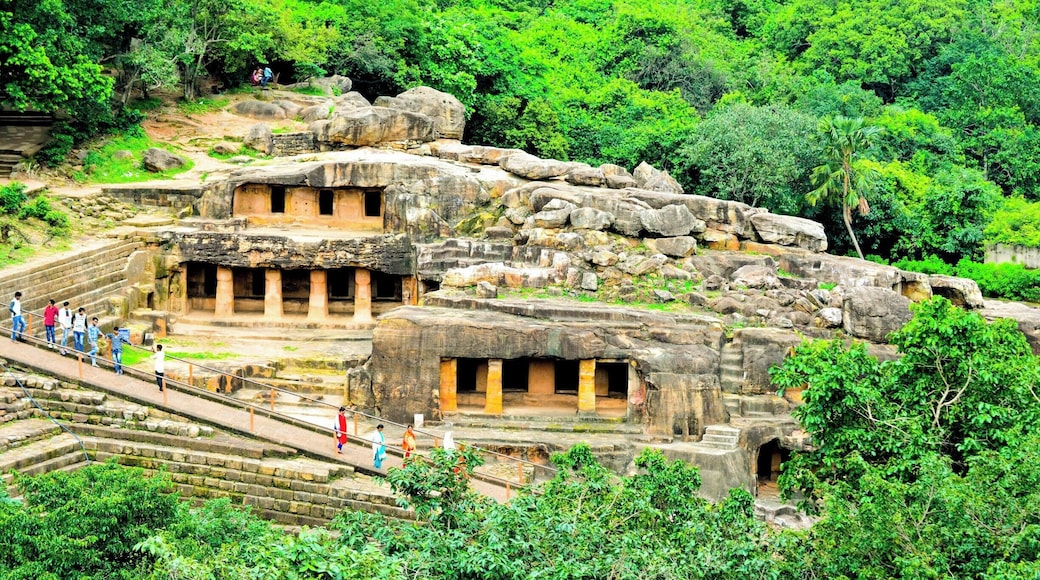
Khandagirigrotten

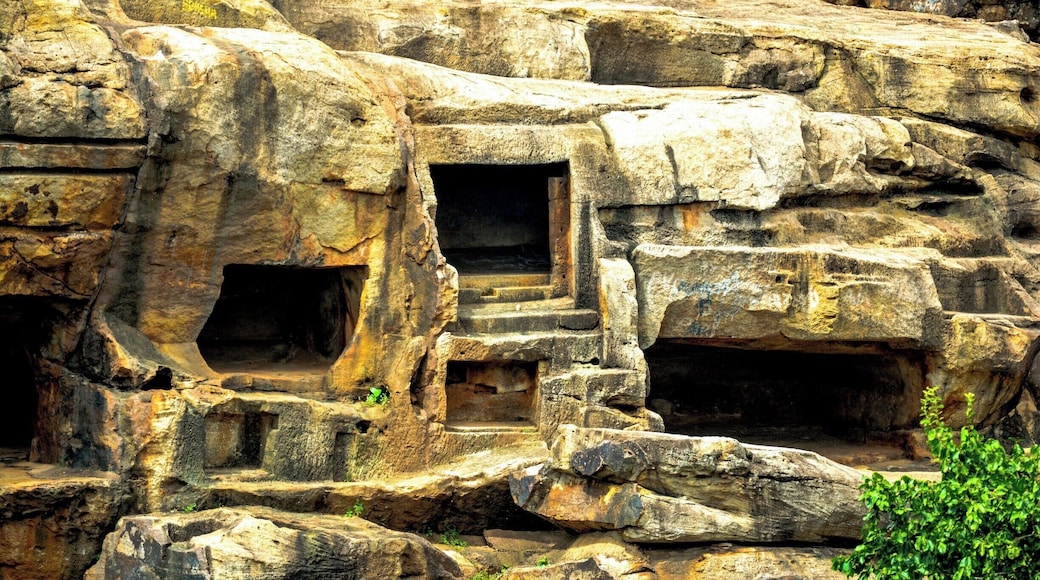
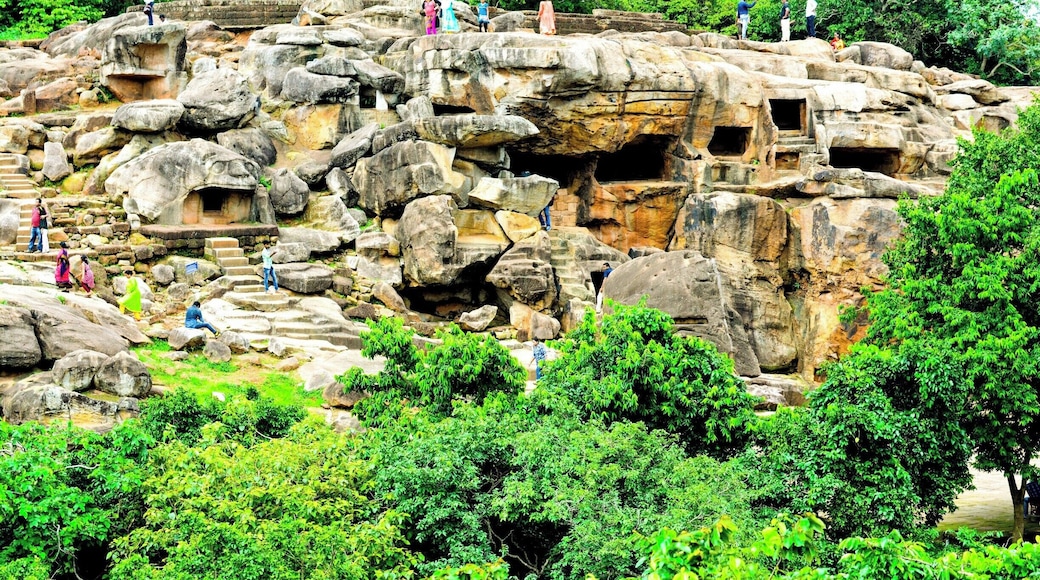
Udayagiri and Khandagiri Caves are partly natural and partly artificial caves of archaeological, historical and religious importance near the city of Bhubaneswar in Odisha, India. The caves are situated on two adjacent hills, Udayagiri and Khandagiri, mentioned as Kumari Parvat in the Hathigumpha inscription. They have a number of finely and ornately carved caves built during 2nd century BCE. It is believed that most of these caves were carved out as residential blocks for Jain monks during the reign of King Kharavela. Udayagiri means "Sunrise Hill" and has 18 caves while Khandagiri has 15 caves.

The caves of Udayagiri and Khandagiri, called lena or leṇa in the inscriptions, were dug out mostly during the reign of Kharavela for the abode of Jaina ascetics. The most important of this group is Ranigumpha in Udayagiri which is a double storeyed monastery. Other important caves include Hathi gumpha, Ananta gumpha, Ganesha gumpha, Jaya Vijaya gumpha, Mancapuri gumpha, Bagh gumpha and Sarpa gumpha.
Udayagiri and Khandagiri Caves are partly natural and partly artificial caves of archaeological, historical and religious importance near the city of Bhubaneswar in Odisha, India. The caves are situated on two adjacent hills, Udayagiri and Khandagiri, mentioned as Kumari Parvat in the Hathigumpha inscription. They have a number of finely and ornately carved caves built during 2nd century BCE. It is believed that most of these caves were carved out as residential blocks for Jain monks during the reign of King Kharavela. Udayagiri means "Sunrise Hill" and has 18 caves while Khandagiri has 15 caves.

The caves of Udayagiri and Khandagiri, called lena or leṇa in the inscriptions, were dug out mostly during the reign of Kharavela for the abode of Jaina ascetics. The most important of this group is Ranigumpha in Udayagiri which is a double storeyed monastery. Other important caves include Hathi gumpha, Ananta gumpha, Ganesha gumpha, Jaya Vijaya gumpha, Mancapuri gumpha, Bagh gumpha and Sarpa gumpha.
Udayagiri and Khandagiri Caves are partly natural and partly artificial caves of archaeological, historical and religious importance near the city of Bhubaneswar in Odisha, India. The caves are situated on two adjacent hills, Udayagiri and Khandagiri, mentioned as Kumari Parvat in the Hathigumpha inscription. They have a number of finely and ornately carved caves built during 2nd century BCE.[1] It is believed that most of these caves were carved out as residential blocks for Jain monks during the reign of King Kharavela.[2] Udayagiri means "Sunrise Hill" and has 18 caves while Khandagiri has 15 caves.[3]

The caves of Udayagiri and Khandagiri, called lena or leṇa in the inscriptions, were dug out mostly during the reign of Kharavela for the abode of Jaina ascetics. The most important of this group is Ranigumpha in Udayagiri which is a double storeyed monastery. Other important caves include Hathi gumpha, Ananta gumpha, Ganesha gumpha, Jaya Vijaya gumpha, Mancapuri gumpha, Bagh gumpha and Sarpa gumpha.
Udayagiri and Khandagiri Caves are partly natural and partly artificial caves of archaeological, historical and religious importance near the city of Bhubaneswar in Odisha, India. The caves are situated on two adjacent hills, Udayagiri and Khandagiri, mentioned as Kumari Parvat in the Hathigumpha inscription. They have a number of finely and ornately carved caves built during 2nd century BCE.[1] It is believed that most of these caves were carved out as residential blocks for Jain monks during the reign of King Kharavela.[2] Udayagiri means "Sunrise Hill" and has 18 caves while Khandagiri has 15 caves.[3]

The caves of Udayagiri and Khandagiri, called lena or leṇa in the inscriptions, were dug out mostly during the reign of Kharavela for the abode of Jaina ascetics. The most important of this group is Ranigumpha in Udayagiri which is a double storeyed monastery. Other important caves include Hathi gumpha, Ananta gumpha, Ganesha gumpha, Jaya Vijaya gumpha, Mancapuri gumpha, Bagh gumpha and Sarpa gumpha.
Udayagiri and Khandagiri Caves are partly natural and partly artificial caves of archaeological, historical and religious importance near the city of Bhubaneswar in Odisha, India. The caves are situated on two adjacent hills, Udayagiri and Khandagiri, mentioned as Kumari Parvat in the Hathigumpha inscription. They have a number of finely and ornately carved caves built during 2nd century BCE. It is believed that most of these caves were carved out as residential blocks for Jain monks during the reign of King Kharavela. Udayagiri means "Sunrise Hill" and has 18 caves while Khandagiri has 15 caves.

The caves of Udayagiri and Khandagiri, called lena or leṇa in the inscriptions, were dug out mostly during the reign of Kharavela for the abode of Jaina ascetics. The most important of this group is Ranigumpha in Udayagiri which is a double storeyed monastery. Other important caves include Hathi gumpha, Ananta gumpha, Ganesha gumpha, Jaya Vijaya gumpha, Mancapuri gumpha, Bagh gumpha and Sarpa gumpha.


Populaire plekken om te bezoeken


Beste hotelaanbiedingen in Khandagirigrotten

Welcomhotel by ITC Hotels, Bhubaneswar

Welcomhotel by ITC Hotels, Bhubaneswar

5 out of 5
D/1, Dumuduma Bhubaneshwar OR
Welcomhotel by ITC Hotels, Bhubaneswar
Vivanta Bhubaneswar DN Square

Vivanta Bhubaneswar DN Square

5 out of 5
DN Regalia, NH16 Patrapada Bhubaneshwar Odisha
Vivanta Bhubaneswar DN Square
Mayfair Lagoon

Mayfair Lagoon

5 out of 5
Jaydev Vihar Bhubaneshwar Orissa
Mayfair Lagoon
Treebo Airport Inn

Treebo Airport Inn

3 out of 5
Plot no-1485 Friends Colony, Baramunda Bhubaneshwar Bhubaneshwar
Treebo Airport Inn
Hotel Satya Inn

Hotel Satya Inn

2 out of 5
2/C Jagmohan Nagar Bhubaneshwar OD
Hotel Satya Inn
Laagste prijs per nacht gevonden in de afgelopen 24 uur op basis van een verblijf van 1 nacht voor 2 volwassenen. Prijzen en beschikbaarheid kunnen altijd wijzigen. Mogelijk gelden er extra voorwaarden.