Banjarsari

Surakarta

At the museum no photos are allowed which is really unfortunate as it was well worth the visit and the guided tour is definitely not to be missed. In the museum there are even Batik made from the Dutch era which depicts stories like Little Red Riding Hood and Snow White!

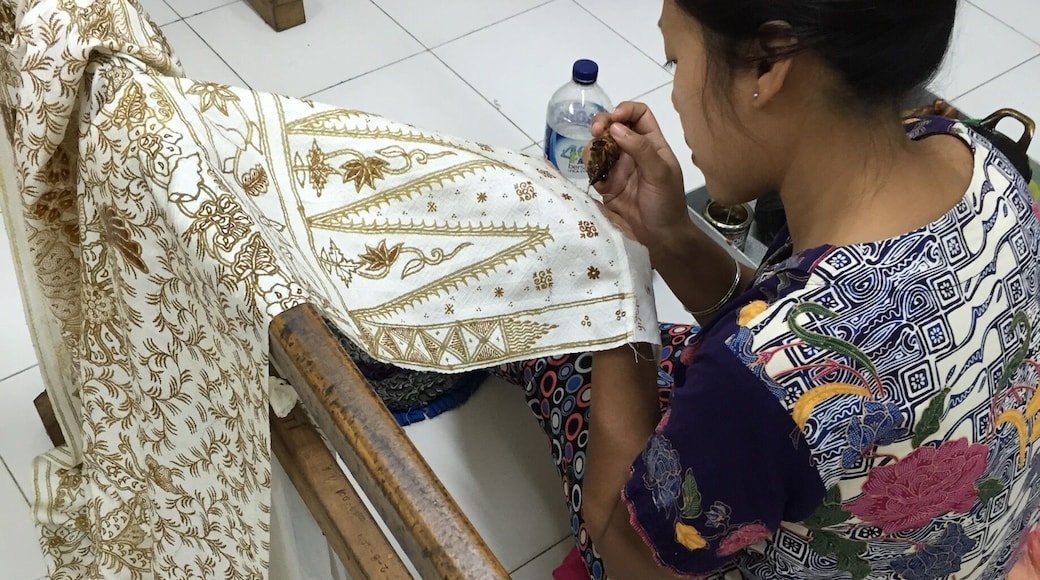
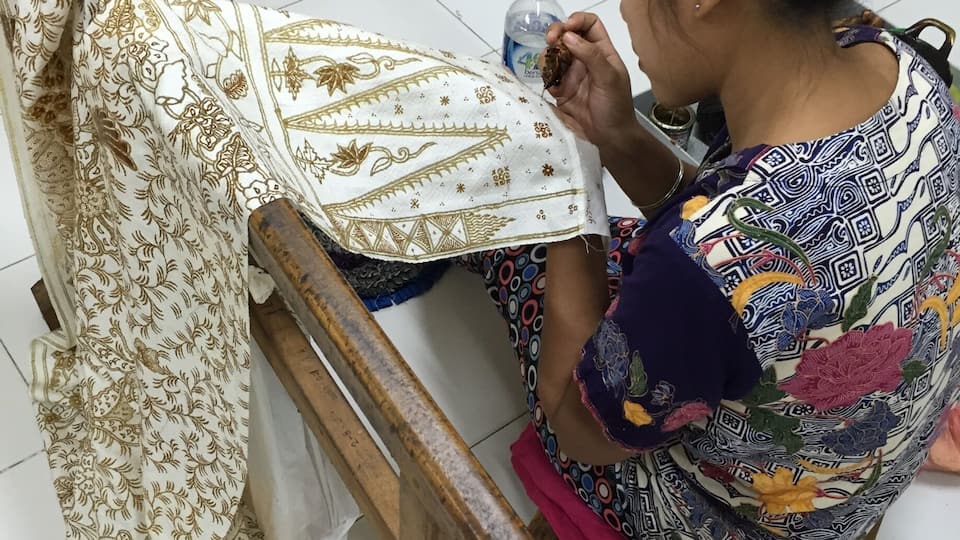
I enjoyed the tour v much and at the end of the tour we were brought to this room where the artisan were working on hand drawn batik.

Below is an excerpt from Wikipedia for anyone interested in learning more about the process of batik making.

Firstly, a cloth is washed, soaked and beaten with a large mallet. Patterns are drawn with pencil and later redrawn using hot wax, usually made from a mixture of paraffin or bees wax, sometimes mixed with plant resins, which functions as a dye-resist. The wax can be applied with a variety of tools. A pen-like instrument called a canting (IPA: [tʃantiŋ], sometimes spelled with old Dutch orthography tjanting) is the most common. A canting is made from a small copper reservoir with a spout on a wooden handle. The reservoir holds the resist which flows through the spout, creating dots and lines as it moves. For larger patterns, a stiff brush may be used. Alternatively, a copper block stamp called a cap (IPA: [tʃap]; old spelling tjap) is used to cover large areas more efficiently.

After the cloth is dry, the resist is removed by scraping or boiling the cloth. The areas treated with resist keep their original color; when the resist is removed the contrast between the dyed and undyed areas forms the pattern. This process is repeated as many times as the number of colors desired.

The most traditional type of batik, called batik tulis (written batik), is drawn using only the canting. The cloth need to be drawn on both sides and dipped in a dye bath three to four times. The whole process may take up to a year; it yields considerably finer patterns than stamped batik.

Source: Wikipedia
At the museum no photos are allowed which is really unfortunate as it was well worth the visit and the guided tour is definitely not to be missed. In the museum there are even Batik made from the Dutch era which depicts stories like Little Red Riding Hood and Snow White!

I enjoyed the tour v much and at the end of the tour we were brought to this room where the artisan were working on hand drawn batik.

Below is an excerpt from Wikipedia for anyone interested in learning more about the process of batik making.

Firstly, a cloth is washed, soaked and beaten with a large mallet. Patterns are drawn with pencil and later redrawn using hot wax, usually made from a mixture of paraffin or bees wax, sometimes mixed with plant resins, which functions as a dye-resist. The wax can be applied with a variety of tools. A pen-like instrument called a canting (IPA: [tʃantiŋ], sometimes spelled with old Dutch orthography tjanting) is the most common. A canting is made from a small copper reservoir with a spout on a wooden handle. The reservoir holds the resist which flows through the spout, creating dots and lines as it moves. For larger patterns, a stiff brush may be used. Alternatively, a copper block stamp called a cap (IPA: [tʃap]; old spelling tjap) is used to cover large areas more efficiently.

After the cloth is dry, the resist is removed by scraping or boiling the cloth. The areas treated with resist keep their original color; when the resist is removed the contrast between the dyed and undyed areas forms the pattern. This process is repeated as many times as the number of colors desired.

The most traditional type of batik, called batik tulis (written batik), is drawn using only the canting. The cloth need to be drawn on both sides and dipped in a dye bath three to four times. The whole process may take up to a year; it yields considerably finer patterns than stamped batik.

Source: Wikipedia

Populaire plekken om te bezoeken


Tophotels in Banjarsari

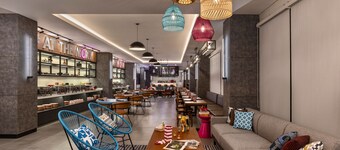
Moxy Solo

Moxy Solo

3.5 out of 5
Jl. Slamet Riyadi No.173, Kemlayan Surakarta Central Java
Volledig restitueerbaarReserveer nu, betaal tijdens je verblijf
De prijs is € 33 per nacht van 18 feb tot 19 feb
€ 33
18 feb - 19 feb
inclusief belastingen en toeslagen
Verblijf bij dit hotel in Surakarta. Geniet van gratis wifi, gratis parkeerplaatsen en ontbijt. De populaire attracties Radya museum bibliotheek en Mangkunegaran ...
9,2/10 Wonderful! (7 beoordelingen)
It was a chic and clean hotel in the center of the city. The staff was very friendly.

Beoordeeld op 28 dec 2024

Moxy Solo
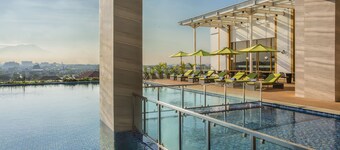
Novotel Solo

Novotel Solo

4 out of 5
Jalan Slamet Riyadi 272 Surakarta Central Java
De prijs is € 28 per nacht van 11 feb tot 12 feb
€ 28
11 feb - 12 feb
inclusief belastingen en toeslagen
Verblijf bij dit hotel met een spa in Surakarta. Geniet van gratis wifi, gratis parkeerplaatsen en 2 buitenzwembaden. De populaire attracties Danar Hadi en Radya ...
8/10 Very Good! (113 beoordelingen)
A great hotel. Staff was friendly. I will surely come back again

Beoordeeld op 18 sep 2024

Novotel Solo
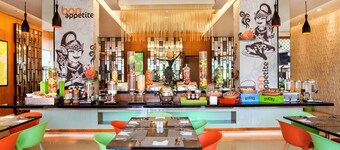
Swiss-Belhotel Solo

Swiss-Belhotel Solo

4 out of 5
Jalan Ahmad Yani 45 Surakarta Jawa Tengah
De prijs is € 41 per nacht van 1 feb tot 2 feb
€ 41
1 feb - 2 feb
inclusief belastingen en toeslagen
Verblijf bij dit hotel met een spa in Surakarta. Geniet van gratis wifi, gratis parkeerplaatsen en een volledig uitgeruste spa. De populaire attracties Nakamura ...
9,2/10 Wonderful! (37 beoordelingen)
お部屋はとても清潔でしっかり掃除もされていて、お部屋に変な匂いもなく(これは重要!)快適でした。タオルも上質で気持ち良かったです。 朝食、夕食でレストラン利用しましたが、テラス席が気持ちよかったです。 2回目の宿泊ですが、ソロに来たらまたココに泊まります!

Beoordeeld op 9 nov 2025

Swiss-Belhotel Solo
Red Chilies Hotel

Red Chilies Hotel

3.5 out of 5
jl aA Yani 286 gondang Surakarta Central Hotel
Verblijf bij dit hotel voor zakenreizigers in Surakarta. Geniet van gratis wifi, gratis parkeerplaatsen en ontbijt. De populaire attracties Balekambang-park ...
Red Chilies Hotel
ibis Styles Solo

ibis Styles Solo

3 out of 5
Jalan Gajah Mada 23 Surakarta Central Java
De prijs is € 22 per nacht van 12 feb tot 13 feb
€ 22
12 feb - 13 feb
inclusief belastingen en toeslagen
Verblijf bij dit hotel met een spa in Surakarta. Geniet van gratis wifi, gratis parkeerplaatsen en 2 buitenzwembaden. De populaire attracties Radya Pustaka Museum ...
8/10 Very Good! (103 beoordelingen)
Sauna was just a cabin with no relax area. Steamroom, etc were closed and in need of repair. Did not look like the pics of Expedia at all.

Beoordeeld op 14 apr 2025

ibis Styles Solo
FIM by Zigna

FIM by Zigna

3 out of 5
31 Jl. Yosodipuro Surakarta Jawa Tengah
Verblijf bij dit hotel met een spa in Surakarta. Geniet van gratis wifi, gratis parkeerplaatsen en een volledig uitgeruste spa. De populaire attracties Nakamura ...
9,4/10 Exceptional! (6 beoordelingen)
The hotel is an excellent place to stay. The hotel itself is not special or fancy, but it is well-run, clean, and located in the center of Solo. The breakfast buffet is excellent, the restaurant is good, and the hotel also has a nice cafe with an outside seating area. They featured life music at ...

Beoordeeld op 19 jul 2025

FIM by Zigna
Laagste prijs per nacht gevonden in de afgelopen 24 uur op basis van een verblijf van 1 nacht voor 2 volwassenen. Prijzen en beschikbaarheid kunnen altijd wijzigen. Mogelijk gelden er extra voorwaarden.

Andere buurten in Banjarsari

At the museum no photos are allowed which is really unfortunate as it was well worth the visit and the guided tour is definitely not to be missed. In the museum there are even Batik made from the Dutch era which depicts stories like Little Red Riding Hood and Snow White!

I enjoyed the tour v much and at the end of the tour we were brought to this room where the artisan were working on hand drawn batik.

Below is an excerpt from Wikipedia for anyone interested in learning more about the process of batik making.

Firstly, a cloth is washed, soaked and beaten with a large mallet. Patterns are drawn with pencil and later redrawn using hot wax, usually made from a mixture of paraffin or bees wax, sometimes mixed with plant resins, which functions as a dye-resist. The wax can be applied with a variety of tools. A pen-like instrument called a canting (IPA: [tʃantiŋ], sometimes spelled with old Dutch orthography tjanting) is the most common. A canting is made from a small copper reservoir with a spout on a wooden handle. The reservoir holds the resist which flows through the spout, creating dots and lines as it moves. For larger patterns, a stiff brush may be used. Alternatively, a copper block stamp called a cap (IPA: [tʃap]; old spelling tjap) is used to cover large areas more efficiently.

After the cloth is dry, the resist is removed by scraping or boiling the cloth. The areas treated with resist keep their original color; when the resist is removed the contrast between the dyed and undyed areas forms the pattern. This process is repeated as many times as the number of colors desired.

The most traditional type of batik, called batik tulis

Centrum van Solo

4/5(2 beoordelingen over de buurt)

Geniet van de musea en de dierentuin in Centrum van Solo. Maak ook wat tijd vrij voor een bezoek aan Solo Paragon Lifestyle Mall of Keprabon Park.

Centrum van Solo


Banjarsari

Kies twee of meer items en bespaar op je reis: